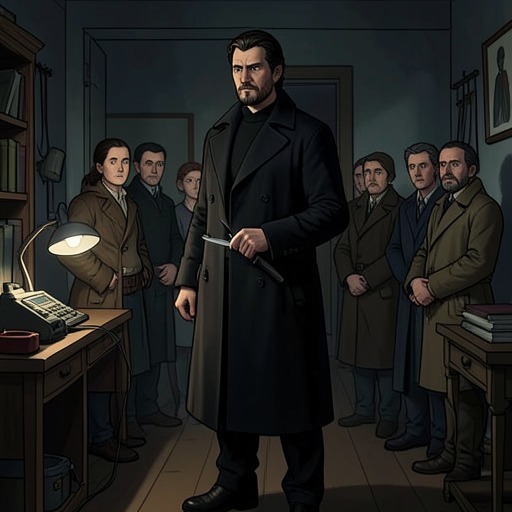
Danny
The Minds of Billy MilliganDanny is the fourteen-year-old personality known as the frightened one within William Stanley Milligan. Afraid of people, especially men, he is associated with an early experience of being forced to dig his own grave and buried alive. That history helps explain both the narrow world fear imposes on him and the importance of the occasions when he can paint, make a friend, or walk outdoors without terror. Across the narrative, Danny is not simply a recollection of childhood: he appears in the present as a distinct and vulnerable personality, sometimes with no understanding of where he is or what has happened around him.
Identity and Background
The book identifies Danny as fourteen, short and slender, with shoulder-length blond hair and blue eyes. His defining description is emotional rather than physical: he is frightened of people, particularly men. The narrative links this fear to the grave he was forced to dig for himself before being buried alive. It also connects that experience to his artistic preference. Danny paints still lifes, a choice that distinguishes his work from the broader range of portraits, still lifes, and landscapes William Stanley Milligan paints at another point in the account.
Danny’s age and fear place him in a markedly different position from the adults who direct events around him. When he appears, he may not recognize the person speaking to him, know where he is, or understand what is expected of him. His limited grasp of the immediate situation is not presented as deliberate resistance. It is part of the vulnerability that defines his episodes, and it makes ordinary surroundings—other people, loud sounds, a vehicle, or a hospital—potentially bewildering.
Fear, Memory, and the Return of Trauma
In one encounter, Danny initially looks around without recognizing the woman addressing him. When he answers, his speech identifies him as a boy with a Cockney accent. He conveys that the sounds around him are overwhelming and that he does not know what is happening. The scene gives his fear a specific form: confusion arrives alongside heightened awareness of other people and their voices. Rather than explain his history, Danny’s sudden presence makes the difficulty of the moment visible in his uncertainty.
The association between present danger and earlier trauma recurs when Timothy is approached by the owner of a business where he works. Frightened, Timothy leaves the spot and withdraws into his own world; Danny then sees what the man was attempting and screams before fleeing. The book explicitly connects Danny’s response to what happened to him on the farm. The episode shows how a threat directed at another personality can bring Danny forward, and how an earlier experience continues to govern his sense of safety even when the circumstances have changed.
A later scene makes the same vulnerability apparent through a much smaller gesture. When Danny sees the protective wire frame inside a car, he draws away and trembles rather than getting into the back seat. The narrative does not need to explain his reaction at length: the resemblance to a cage is enough to make the vehicle unapproachable. In another episode, he hears girls call to William Stanley Milligan and sees that they are intoxicated. He recoils, covers his face, and turns back toward the building with Gus Holston. These scenes show that Danny’s fear is not confined to a single remembered event; it shapes how he responds to people and settings in the present.
Painting and a First Friendship
Painting gives Danny a repeated activity that is both personal and recognizable. He paints still lifes, and at one point, after another personality leaves the spot, Danny begins painting even though it is late. The quietness of the activity contrasts with the confusion and fear of his appearances. It gives him a way to occupy the present without requiring him to explain himself to others.
One painting becomes a moment of self-identification. Danny picks up the work, struggles to hold back tears, and takes it to the painting room. For the first time, he signs it with his name and the year 1970, then fills out the information requested on the back of the canvas board. The act is modest but consequential: the painting is no longer only something he has made; it is also something he claims as Danny’s work. The signature makes his presence legible through an object, even as his place in the larger life remains unstable.
The narrative also recalls Danny making friends with a young Black boy. They talk and play, then stay up late describing what they would like to do when they grew up. It is the first time Danny ever laughs. The importance of this friendship lies in its ordinary reciprocity: the two children share play and imagined futures, rather than relating through threat or confusion. Against the account of Danny’s fear of people, the detail of his laughter registers a genuine opening toward companionship.
Episodes in Hospitals and Public Life
Danny appears during the journey along snow-covered Route 33 toward Athens. As the vehicle passes through Lancaster, the narrative recalls that William Stanley Milligan was raised there, went to school there, and tried to kill himself there. Overwhelmed and exhausted, he closes his eyes and lets go; seconds later, Danny looks around, cold, lonely, and afraid, unsure where he is being taken. The shift makes the journey more than a transfer between places. For Danny, it begins without a comprehensible destination.
At the hospital in Athens, the officers lead him from the van up the steps of an old red-brick building with white pillars. He trembles as they approach. When Dr. David Caul calls Danny, the doctor jumps up and shuts the door in his face. Dr. David Caul recognizes that dissociation has occurred and recalls that the earlier fusion had seemed fragile. He understands that a stressful situation such as a trial could lead to unfusion, and that he must first gain Danny’s confidence. The encounter places Danny’s fear inside a clinical setting while also showing that the clinician does not mistake the change in personality for simple refusal.
Danny is also introduced to Judy Stevenson and later to Cornelia Wilbur. Dorothy Turner tells Judy that she has come to know Danny quite well, then presents Danny to Cornelia Wilbur and seats him nearby. These introductions establish that the professionals around William Stanley Milligan encounter Danny as a personality in his own right. Yet recognition does not mean that he can readily orient himself. When he later finds himself behind the wheel of a car, he remembers Arthur’s instructions and moves to the passenger side to wait for someone else to drive. Only after recognizing a familiar bathroom stop does he wonder whether the people sitting in two other cars may also have changed spots and be waiting for someone to take them home. His reasoning is childlike, but it shows him trying to apply what he has learned to an unfamiliar situation.
Vulnerability, Change, and Narrative Role
The narrative records Danny in settings where he has little control over what is happening. During a period of prolonged protective isolation, William Stanley Milligan is moved to a section of Lebanon prison reserved for inmates with mental problems; after self-injury and refusal of treatment, he is taken to the Central Medical Center in Columbus and later returned to the prison. The episode belongs to the account of institutional crisis surrounding the larger personality system. It underscores how little security isolation provides in itself and how vulnerable Danny’s world remains amid confinement and disrupted care.
Other scenes offer a different measure of change. At Harding Hospital, Danny’s earlier inability to walk outside without terror is contrasted with a later moment when he finds himself strolling across the grounds. He looks from the old Victorian mansion with its white columns toward the river and town, recognizing that he can now be outdoors without the fear that had once prevented it. The change is specific rather than absolute: the account does not say that Danny is free of fear, but it marks an experience that had previously been impossible for him.
Danny’s role in the book is therefore both personal and structural. His fear, disorientation, and artistic habits give a distinct shape to one part of William Stanley Milligan’s divided experience; his abrupt appearances also make the instability of fusion visible in scenes of travel, treatment, work, and ordinary activity. Painting and the friendship that first makes him laugh do not erase the trauma associated with him. Instead, they show what can exist alongside it: a name written on a canvas, a shared conversation about the future, and an outdoor walk taken without terror.